USG3065M 6.5 GHz Analog RF Signal Generator
$9 999.00
Add-on Options
In stock
Customer reviews
Reviews only from verified customers
No reviews yet. You can buy this product and be the first to leave a review.
Save this product for later
USG3065M 6.5 GHz Analog RF Signal Generator
Product Details
Warranty: 3 years
Equipment Type: RF Generator
UNI-T USG3065M | Professional RF Signal Generator (9 kHz to 6.5 GHz)
Overview
The UNI-T USG3065M RF signal generator delivers exceptional performance with extended frequency coverage from 9 kHz to 6.5 GHz, making it ideal for wireless communications, component testing, and research applications across a wider range of communications bands. Featuring high signal purity, precise level control, and comprehensive modulation capabilities, this instrument provides the reliability and accuracy that RF professionals demand in today's challenging testing environments.
Engineered for professional testing needs, the USG3065M combines advanced RF signal generation capabilities with an intuitive user interface and versatile connectivity options. The exceptional signal quality with low phase noise (<-122 dBc/Hz @ 1 GHz, 20 kHz offset) ensures accurate measurements for critical applications. Whether you're working with 5G sub-6 GHz systems, WiFi 6/6E, advanced automotive electronics, or general RF development, the USG3065M provides the frequency coverage, measurement accuracy, modulation capabilities, and ease of operation needed to solve your most challenging RF testing requirements.
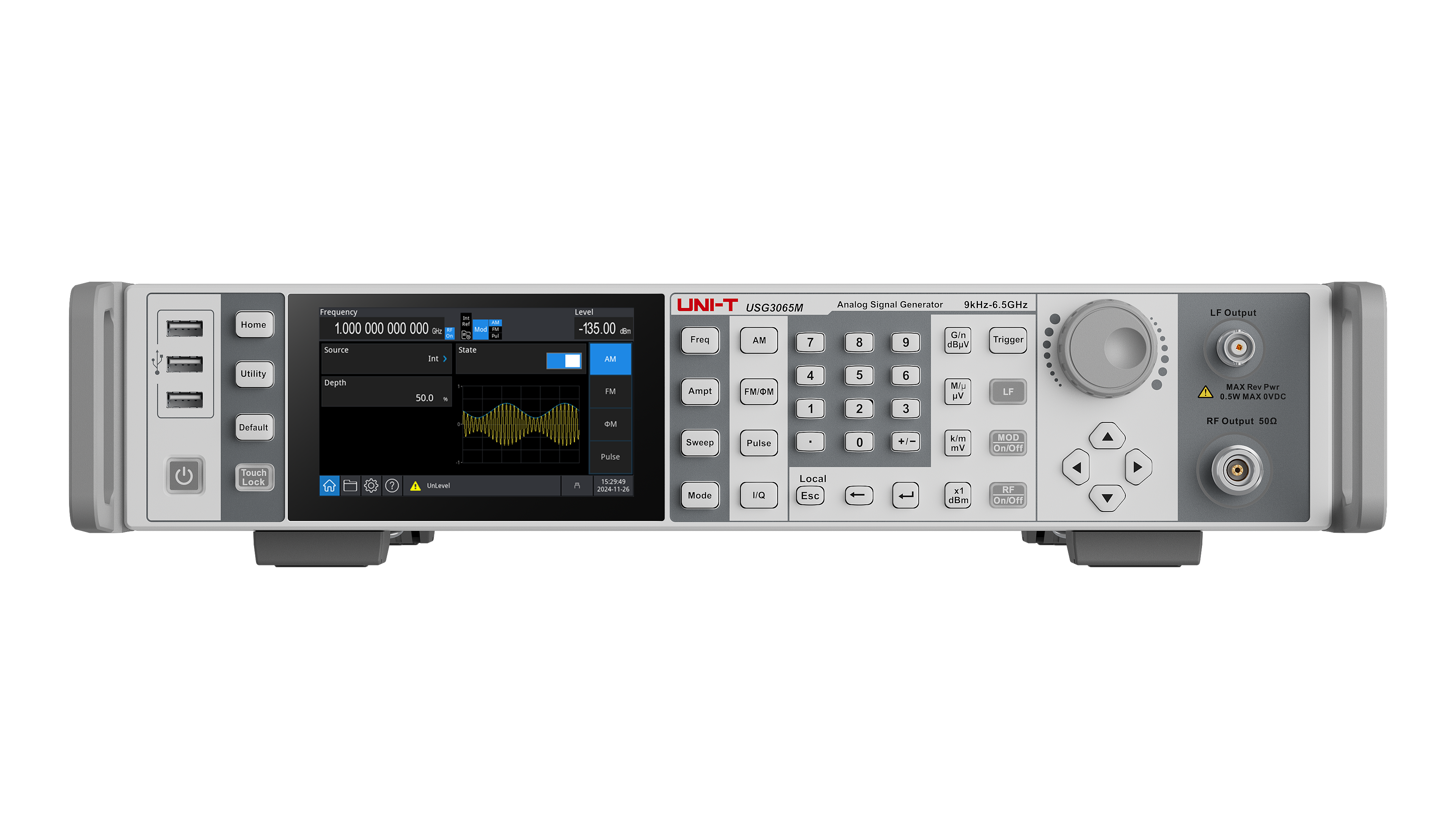
USG3000M RF Signal Generator with professional-grade performance
Key Features
- Extended Frequency Coverage - Generates signals from 9 kHz to 6.5 GHz with ultra-fine 0.001 Hz resolution for precise testing
- Wide Output Range - Adjustable output levels from -135 dBm to +20 dBm to meet diverse testing requirements
- Superior Signal Quality - Low phase noise (<-122 dBc/Hz @ 1 GHz, 20 kHz offset) ensures accurate measurements
- Versatile Modulation - AM, FM, and ΦM capabilities with internal, external, or combined modulation sources
- Intuitive Operation - 5-inch capacitive touch screen with clear visual feedback and logical menu organization
- Flexible Connectivity - Remote control via LAN and USB interfaces for automated testing environments
- Integrated Function Generator - Built-in 50 MHz function/arbitrary waveform generator adds versatility
- Electronic Attenuator - Provides reliable output level control with 0.01 dB resolution
- 5G Coverage - Complete frequency coverage for all sub-6 GHz 5G bands and applications
- Comprehensive Sweep Capabilities - Frequency, amplitude, and list sweep modes with customizable parameters
- Advanced Pulse Modulation - Optional pulse modulation with on-off ratios up to 80 dB (USG3000M-PM)
- Narrow Pulse Generator - Optional pulses as narrow as 20 ns with 10 ns resolution (USG3000M-PG)
High Performance Signal Generation
The USG3065M delivers precision RF signal generation with exceptional purity across its extended frequency range of 9 kHz to 6.5 GHz. With phase noise performance of <-122 dBc/Hz at 1 GHz (20 kHz offset), the signal generator provides the clean signal sources necessary for accurate component characterization and receiver testing. The high-performance RF architecture ensures superior harmonic suppression (≤ -50 dBc from 10 MHz to 1 GHz, ≤ -40 dBc from 1 GHz to 4.5 GHz, and ≤ -35 dBc from 4.5 GHz to 6.5 GHz), enabling confident measurements without interference from unwanted signal components.
The outstanding frequency resolution of 0.001 Hz allows for ultra-precise frequency setting, essential for applications requiring exact signal frequencies. Combined with amplitude accuracy of ≤ 0.7 dB (typical), the instrument ensures your test signals meet exact specifications. This exceptional performance makes the USG3065M ideal for applications ranging from cellular and 5G component testing to WiFi 6/6E verification, where signal quality directly impacts measurement validity.
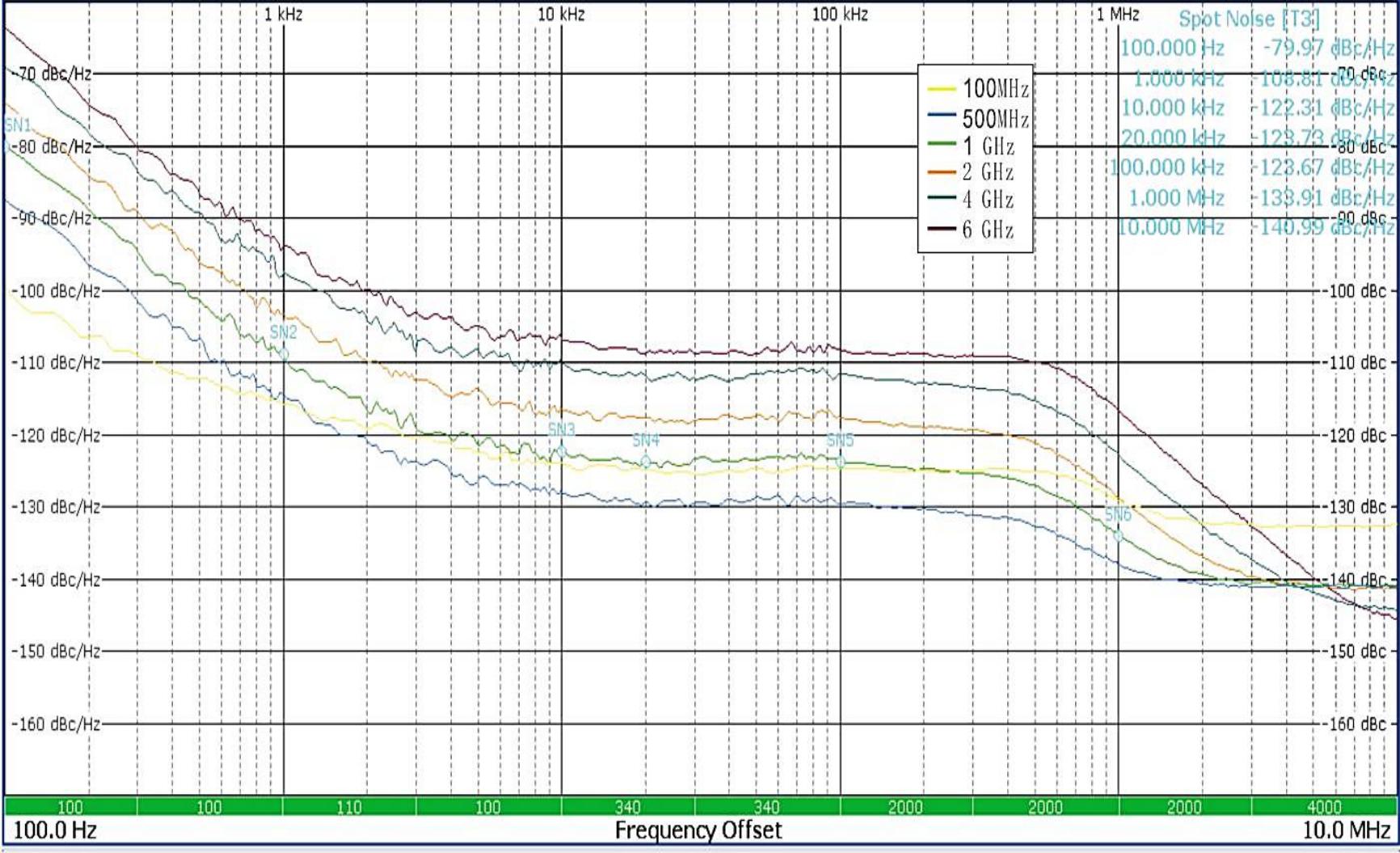
Low phase noise performance ensures high signal purity for precision measurements
Comprehensive Modulation Capabilities
The USG3065M provides versatile modulation capabilities essential for thorough communications system testing. Standard analog modulation includes AM with depths up to 99%, FM with deviation up to 10 MHz, and phase modulation up to 5 radians. The flexible modulation sources allow for internal, external, or combined operation, adapting to diverse testing scenarios. Each modulation type features precise control of parameters, enabling accurate simulation of real-world signal conditions.
For applications requiring pulsed RF signals, the optional USG3000M-PM pulse modulation capability delivers outstanding on-off ratios up to 80 dB with fast rise/fall times below 20 ns. The pulse modulation can operate in various modes including free-running, triggered, gated, and customized pulse train patterns. When combined with the optional USG3000M-PG narrow pulse generator, the system can generate pulses as narrow as 20 ns with 10 ns resolution, perfect for radar system testing and pulse characterization applications.
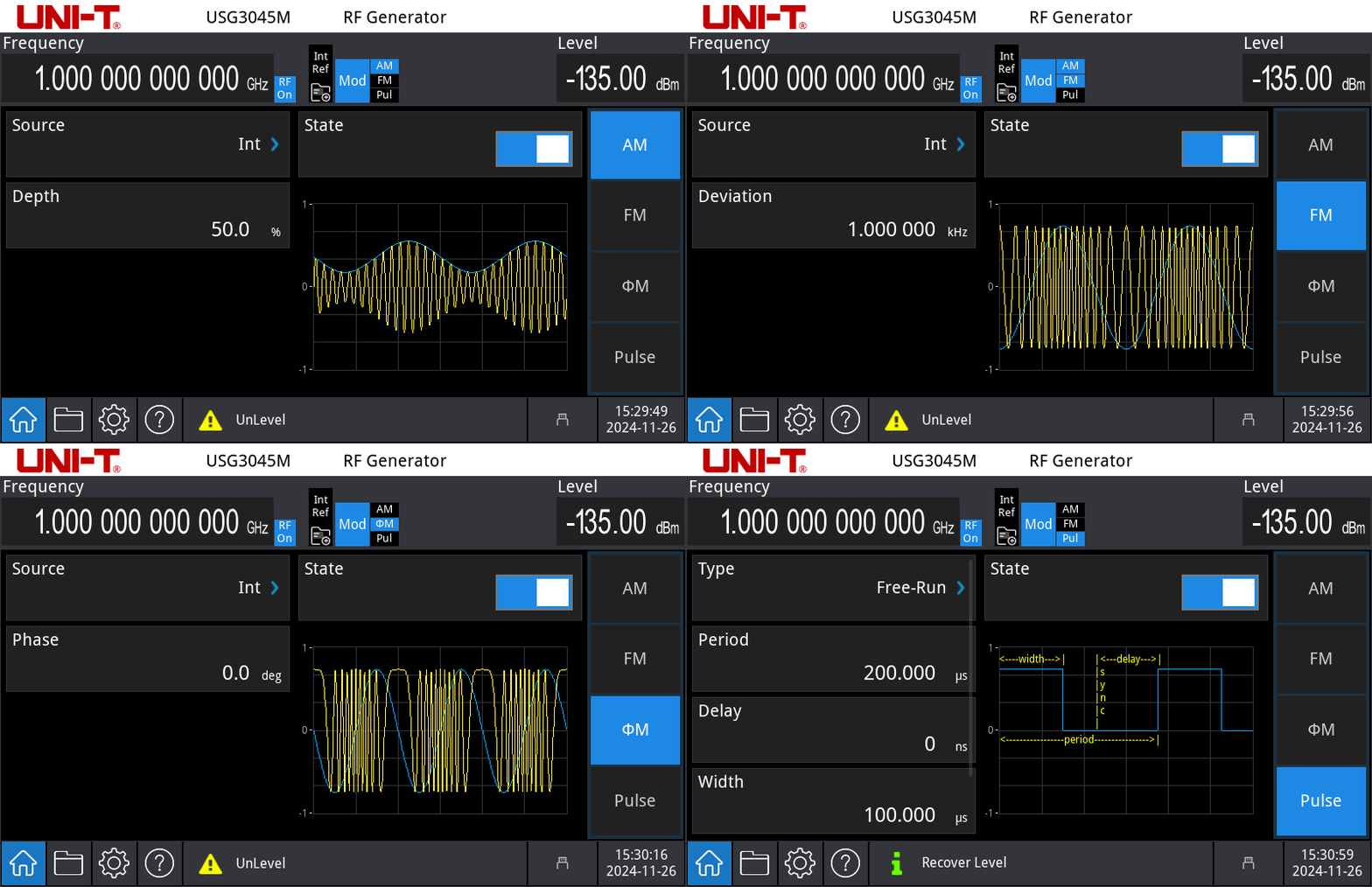
Comprehensive analog modulation capabilities include AM, FM, and ΦM with various modulation sources
High-precision Pulse Generator
USG3065M features a stable clock source and offers optional pulse modulation and a narrow pulse generator. The USG3000M-PG option delivers a minimum pulse width of 20 ns with a resolution of 10 ns, meeting the requirements of automotive millimeter-wave radar systems and advanced timing applications. The pulse generator provides exceptional timing precision and stability across multiple operating modes.
With the optional pulse modulation package, you can generate customized pulse trains with precisely controlled timing parameters. Multiple pulse modes are supported, including Free-Run, Square, External Triggered, Adjustable Doublet, External Trigger Doublet, Gated, External Pulse, and Pulse Train. The outstanding on-off ratio of ≥ 80 dB ensures clear signal transitions with minimal bleed-through, while fast rise/fall times below 20 ns enable accurate simulation of high-speed pulsed systems. These capabilities are essential for radar system testing, pulse characterization, and advanced communications applications.
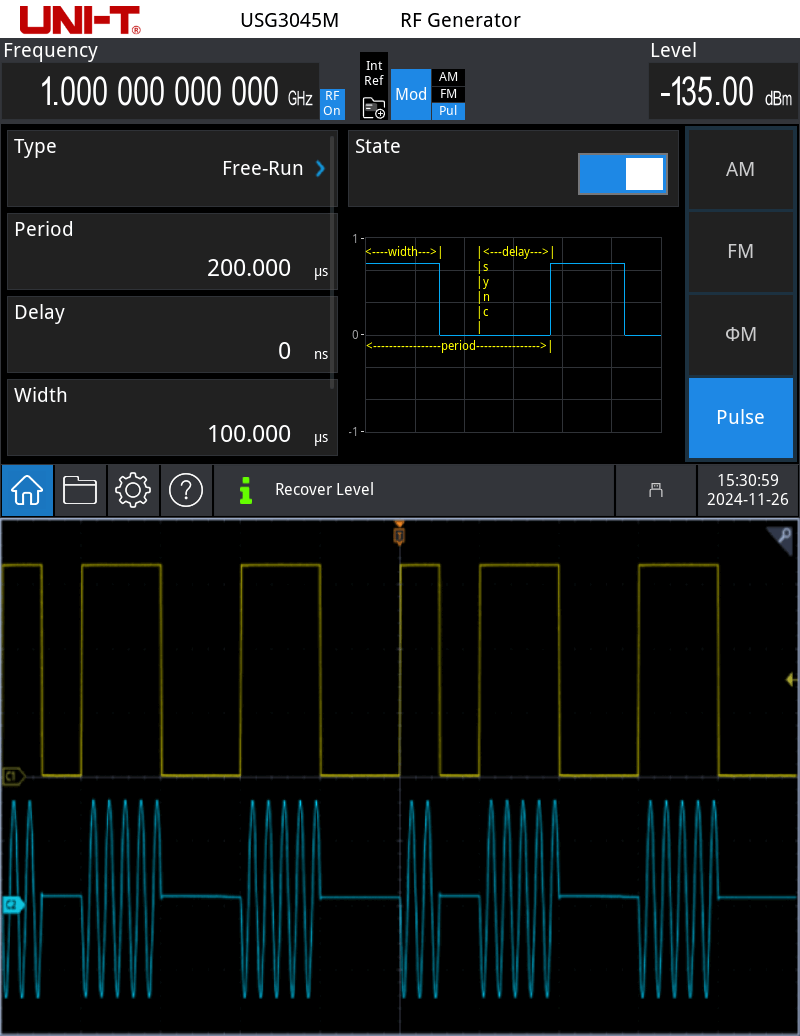
High-precision pulse generator with minimum pulse width of 20 ns and 10 ns resolution
Advanced Sweep Functions
The USG3065M features comprehensive sweep capabilities that simplify component characterization and system response testing. The instrument supports frequency, amplitude, and list sweep modes with customizable step sizes and dwell times. Engineers can perform frequency sweeps across the full 9 kHz to 6.5 GHz range with linear or logarithmic step patterns, enabling efficient measurement of frequency-dependent parameters like filter responses or amplifier gain flatness.
For more complex testing requirements, the list sweep mode allows creation of custom frequency-amplitude point sequences, ideal for focused testing at specific frequencies of interest. Sweep operation can be triggered via multiple methods including free-running, external trigger, manual key press, or computer command, providing flexibility for both manual testing and automated sequences. These advanced sweep functions streamline the characterization process and reduce overall test time compared to point-by-point manual measurements.
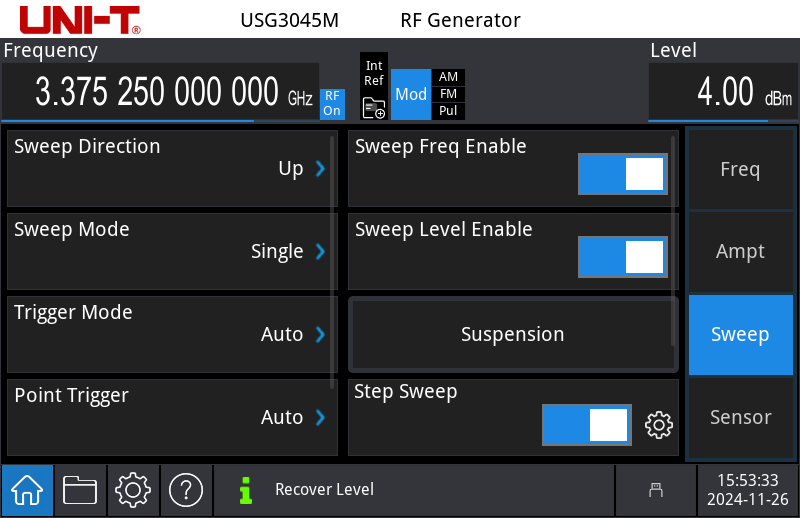
Comprehensive sweep modes including frequency, amplitude, and list sweep with customizable parameters
Intuitive User Interface
The USG3065M features a 5-inch capacitive multi-touch screen with an intuitive user interface that accelerates test setup and enhances productivity. The flat design with clear parameter organization allows for quick access to commonly used functions, while the logical menu structure ensures even complex operations can be performed with minimal keystrokes. The touch interface supports gestures for common operations, reducing setup time and allowing engineers to focus on test results rather than instrument configuration.
Visual feedback is provided through clear waveform displays for both output and modulating signals, enabling immediate verification of signal characteristics. The interface allows seamless switching between time-domain and frequency-domain views, providing comprehensive signal visualization. Numerical parameters are displayed with high visibility and logical grouping, ensuring settings are easily verifiable at a glance. This thoughtful interface design reduces learning curves and improves testing efficiency in both research and production environments.
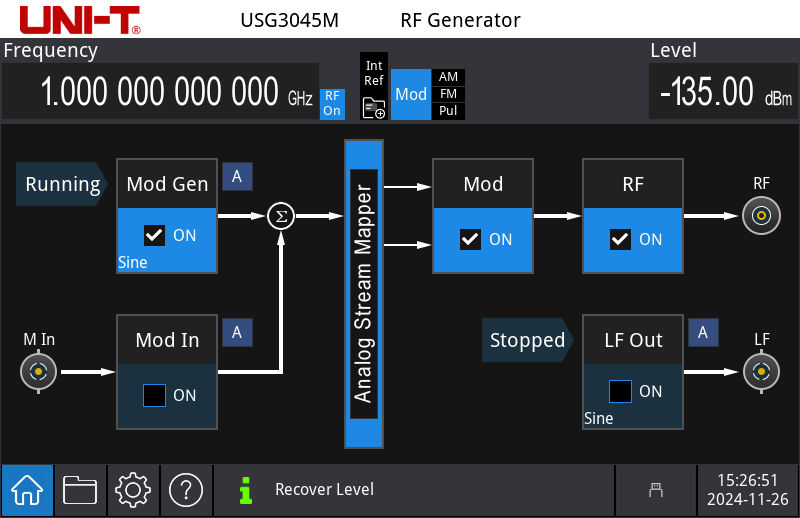
5-inch capacitive multi-touch screen with intuitive, flat design interface for efficient operation
Integrated Function Generator
The USG3065M includes a built-in 50 MHz function/arbitrary waveform generator that extends the instrument's versatility beyond RF applications. This integrated LF generator produces high-quality sine waves up to 50 MHz, square and pulse waveforms up to 15 MHz, and triangular waves up to 3 MHz. With output amplitude adjustable from 1 mVpp to 2 Vpp and DC offset control, it provides the signal flexibility needed for various testing applications without requiring additional equipment.
The function generator includes advanced capabilities such as linear and logarithmic sweep functions and comprehensive modulation options including AM, FM, and pulse modulation. For digital communications testing, it supports ASK, FSK, PSK, and QAM modulation with various digital patterns. This integration delivers significant value by combining two essential instruments in one compact unit, saving both bench space and equipment costs while maintaining signal generation quality.
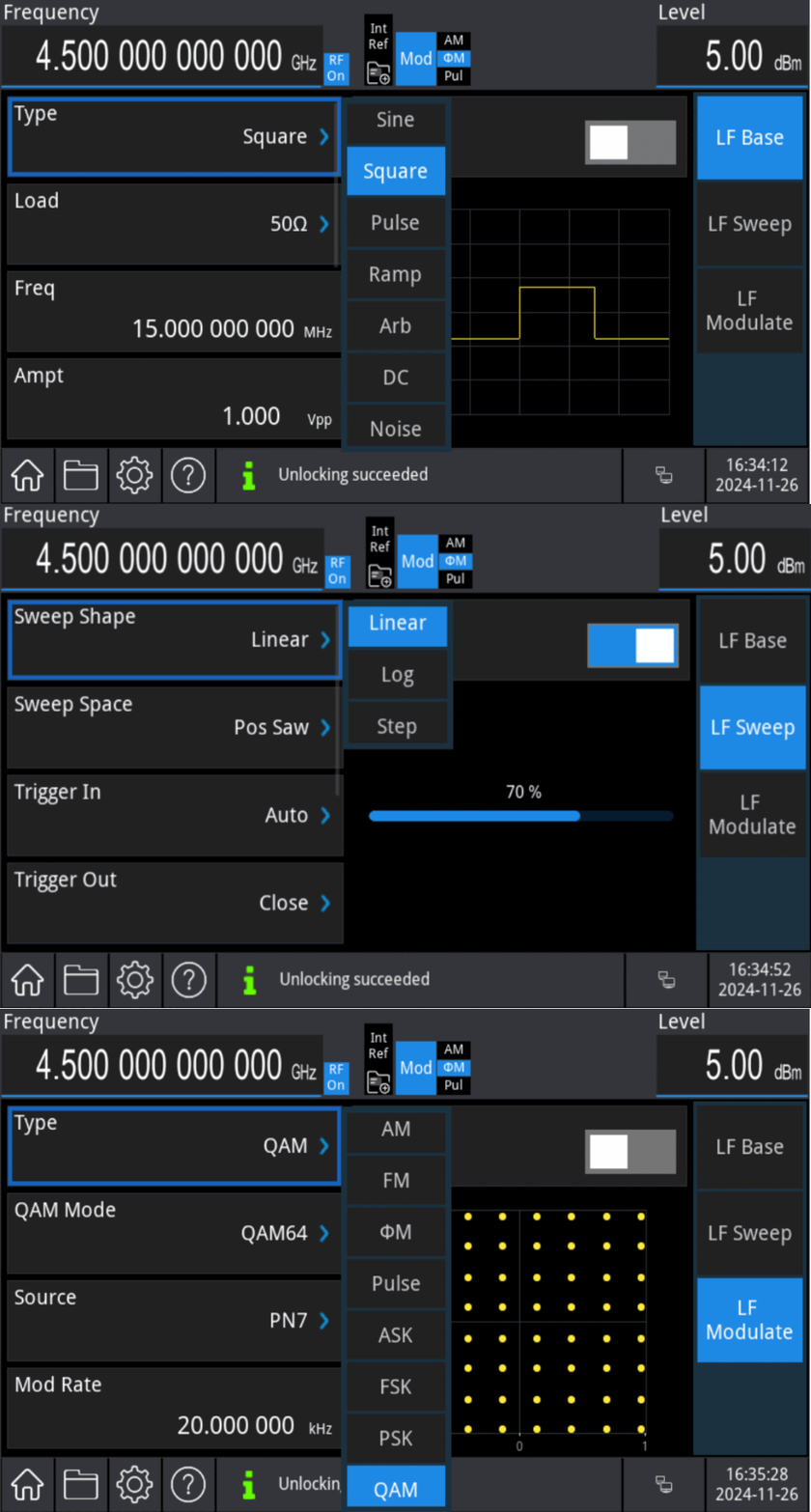
Integrated 50 MHz function/arbitrary waveform generator with comprehensive waveform and modulation capabilities
Optional Power Meter Option
The optional USG3000M-PK power meter option transforms the USG3065M into a comprehensive RF test solution by adding accurate power measurement capabilities. Connected through the front panel USB port, this accessory enables precise RF power measurements, particularly valuable for calibrating output power levels and verifying signal integrity at the device under test. The power measurement system allows direct verification of actual received power, eliminating uncertainty in test setups.
A key capability of the power meter option is the line loss calibration function, which automatically compensates for cable and fixture losses in the test path. This ensures that the power level reaching the device under test matches the specified value, improving measurement accuracy and test consistency. By combining signal generation and power measurement in a single coordinated system, the power meter option streamlines test procedures and reduces the need for additional test equipment, providing significant value for RF development and production test applications.
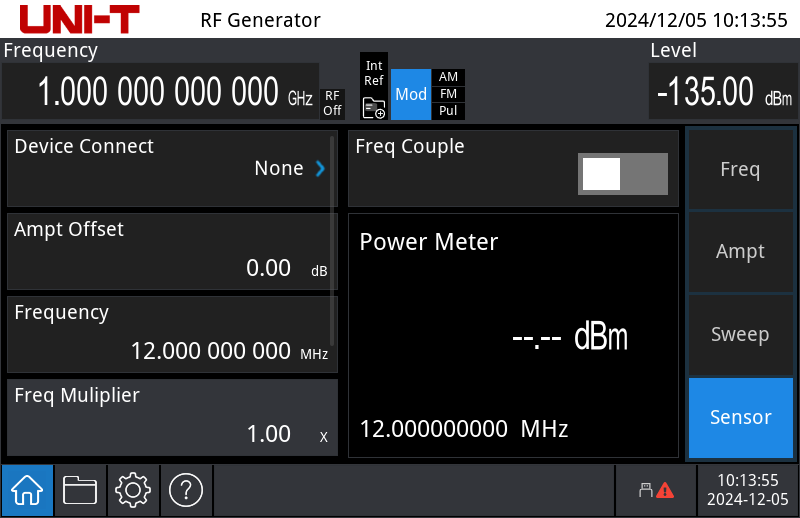
Optional power meter option provides power measurement, output control, and line loss calibration capabilities
Professional Applications
5G Communications Development and Testing
The USG3065M's extended frequency range makes it the ideal choice for 5G sub-6 GHz communications testing. With coverage up to 6.5 GHz, it supports all current 5G NR (New Radio) frequency bands below 6 GHz, including the increasingly important C-band deployments between 3.7-4.2 GHz and the global 5G bands from 5.9-6.4 GHz. Engineers can generate precise test signals with the modulation characteristics needed to verify receiver sensitivity, adjacent channel selectivity, and blocking performance. The instrument's excellent phase noise performance and spectral purity ensure that component and system measurements reflect actual device performance rather than signal source limitations, making the USG3065M invaluable for 5G system development, verification, and production testing.
WiFi 6/6E Testing
For WiFi testing applications, the USG3065M provides complete coverage of all current standards including WiFi 6E, which extends into the 6 GHz band. This makes it perfect for testing access points, client devices, and RF components operating in the 2.4 GHz, 5 GHz, and new 6 GHz bands. The instrument's precise frequency control and modulation capabilities allow engineers to test receiver performance under various signal conditions, while the sweeping functions enable efficient characterization of frequency-dependent parameters critical to WiFi system performance. When combined with the optional power meter, the USG3065M provides a complete solution for WiFi system characterization, from development through production testing.
Educational and Research Facilities
For educational and research applications, the USG3065M provides the comprehensive functionality and frequency coverage needed to support diverse learning and experimental scenarios. The intuitive interface with clear visual feedback simplifies operation for students, while the professional-grade specifications ensure accurate results for serious research. The integrated function generator and optional pulse capabilities expand the instrument's utility across multiple laboratory applications, from basic RF principles to advanced communications theory. The extended frequency range ensures the instrument remains relevant as wireless technologies continue to evolve, making it an excellent investment for forward-looking educational institutions.
General RF Development
RF engineers developing filters, amplifiers, mixers, and other components rely on the USG3065M's signal quality and extended frequency range to characterize device performance. The low phase noise and harmonic content ensure measurements reflect true device characteristics rather than signal generator artifacts. Sweep functions streamline frequency response measurements, while the optional power meter option provides immediate verification of gain or loss figures. The instrument's comprehensive frequency coverage from 9 kHz to 6.5 GHz encompasses virtually all standard RF and microwave development applications below the Ku band, making it an exceptionally versatile tool for general RF engineering tasks from initial prototyping through final validation.
Technical Specifications
| Parameter | Specification |
|---|---|
| Frequency Range | 9 kHz to 6.5 GHz |
| Frequency Resolution | 0.001 Hz |
| Phase Offset | Step of 0.1° |
| Output Level Range | -135 dBm to +20 dBm |
| Amplitude Accuracy | ≤ 0.7 dB (typical) |
| Phase Noise | <-122 dBc/Hz @ 1 GHz, 20 kHz offset (typical) |
| Harmonics | ≤ -50 dBc (10 MHz to 1 GHz), ≤ -40 dBc (1 GHz to 4.5 GHz), ≤ -35 dBc (4.5 GHz to 6.5 GHz) |
| Modulation Types | AM, FM, ΦM (standard); Pulse (optional) |
| Display | 5-inch capacitive multi-touch screen (800×480) |
| Connectivity | LAN (10/100/1000 Base, RJ-45), USB Device, USB Host |
| Optional Interfaces | GPIB (IEEE-488.2) |
| Power Supply | 100 to 240 VAC, 50/60 Hz, <50 W |
| Dimensions (H×W×L) | 426mm × 88mm × 400mm |
| Weight | <20 kg |
| Calibration Period | One year |
USG3000M Series Model Comparison
The USG3000M series offers multiple models to address specific RF testing requirements. The series includes models with different frequency ranges and output power capabilities, allowing you to select the instrument that best meets your application needs and budget constraints.
| Feature | USG3045M | USG3045M-P | USG3065M | USG3065M-P |
|---|---|---|---|---|
| Frequency Range | 9 kHz to 4.5 GHz | 9 kHz to 4.5 GHz | 9 kHz to 6.5 GHz | 9 kHz to 6.5 GHz |
| Mechanical Attenuator | No | Yes | No | Yes |
| Maximum Output Power (250 MHz to 1.2 GHz) | +20 dBm | +24 dBm | +20 dBm | +24 dBm |
| Maximum Output Power (1.2 GHz to 3.6 GHz) | +18 dBm | +22 dBm | +18 dBm | +22 dBm |
| Maximum Output Power (3.6 GHz to 4.5/6.5 GHz) | +15 dBm | +20 dBm | +15 dBm | +20 dBm |
| SSB Phase Noise at 1 GHz, 20 kHz offset (Typ.) | -122 dBc/Hz | -122 dBc/Hz | -122 dBc/Hz | -122 dBc/Hz |
| Step Attenuator | Electronic (0 to 110 dB) | Mechanical (0 to 110 dB) | Electronic (0 to 110 dB) | Mechanical (0 to 110 dB) |
| SWR (1.0 GHz to Max. Freq.) | < 1.8:1 | < 1.6:1 | < 1.8:1 | < 1.6:1 |
Standard Features Across All Models
All USG3000M series models share a common set of core capabilities that ensure professional-grade performance regardless of which variant you select:
- 0.001 Hz frequency resolution
- Automatic Level Control (ALC) with multiple operating modes
- Standard AM, FM, and ΦM modulation
- 5-inch capacitive multi-touch display
- Built-in 50 MHz function/arbitrary waveform generator
- LAN and USB connectivity
- Step, list, and sweep functionality
- Low phase noise and high signal purity
Selecting the Right Model
When choosing between USG3000M series models, consider these factors to determine which variant best meets your requirements:
Frequency Requirements
If your applications only require signals up to 4.5 GHz, the USG3045M models offer excellent value. For higher frequency applications including 5 GHz Wi-Fi bands, 5G sub-6 GHz testing, or other systems operating between 4.5 and 6.5 GHz, select the USG3065M models.
Output Power Needs
The "-P" models with mechanical attenuators provide up to 4 dB more output power, making them ideal for:
- Testing high-attenuation systems
- Driving power amplifiers
- Compensating for lossy test setups
- Applications requiring stronger signals
The standard models with electronic attenuators offer excellent performance for most general-purpose applications at a more economical price point.
Common Options for All Models
All USG3000M series models support the same set of optional capabilities:
- USG3000M-PM: Pulse modulation with 80 dB on-off ratio
- USG3000M-PG: Narrow pulse generator (20 ns minimum width)
- USG3000M-PK: Power meter option
- USG3000M-GPIB: GPIB interface for legacy systems
Available Options and Accessories
| Item | Description | Order No. |
|---|---|---|
| Pulse Modulation | Enables pulse modulation capability | USG3000M-PM |
| Narrow Pulse Generator | Adds narrow pulse generation functionality | USG3000M-PG |
| Power Meter option | Provides power measurement and calibration | USG3000M-PK |
| GPIB Interface | Adds GPIB connectivity for legacy systems | USG3000M-GPIB |
| RF Cable | SMAJ-NJ-0.7M DC-6G cord | UT-W02-6GHz |
| RF Cable | NJ-NJ-0.7M DC-6G cord | UT-W01-6GHz |
| Adapter | SMA-N-KJ-T DC-6GHz | UT-C01-6GHz |
| Adapter | N-BNC-JK DC-4GHz | UT-C02-4GHz |
| Accessories Pouch | Carrying case for accessories | UT-CK01 |
Advanced Pulse Modulation Capabilities
With the optional USG3000M-PM pulse modulation package, the USG3065M delivers sophisticated pulse modulation capabilities essential for radar system testing, pulse characterization, and advanced communications applications. The pulse modulation achieves outstanding on-off ratios of up to 80 dB with fast transition times below 20 ns, ensuring accurate representation of pulsed signals. The instrument supports multiple operating modes including free-running, triggered, gated, and pulse train configurations, accommodating diverse testing requirements.
For applications demanding precise pulse control, the optional USG3000M-PG narrow pulse generator extends capabilities further with pulse widths as narrow as 20 ns and 10 ns resolution. This high-precision timing control is particularly valuable for automotive millimeter-wave radar testing, aerospace applications, and advanced communications system verification. The pulse train mode allows creation of complex pulse patterns with customized timing relationships, enabling accurate simulation of real-world signal environments for thorough system testing.
Front and Rear Panel Overview
Front Panel
The well-organized front panel features a 5-inch capacitive touch display at the center, surrounded by logically grouped control keys. The RF output connector uses an N-type female header for reliable connections, while the LF output provides a BNC connector for function generator signals. The USB host port enables easy connection of peripherals and the optional power meter. The numeric keypad, multi-function rotary knob, and arrow keys provide efficient parameter entry when precise value adjustments are needed.
Rear Panel
The rear panel houses comprehensive connectivity and signal routing options. Communication interfaces include LAN, USB device, and optional GPIB ports for remote control. Signal connections include inputs and outputs for reference signals (10MHz Ref In/Out), trigger signals (Trigger In/Out), modulation (Mod In), and pulse signals (Pulse In/Out). The main power switch and AC power supply connection are positioned for convenient access, while a ground terminal ensures proper system grounding for optimal performance.
Package Contents
- USG3065M RF Signal Generator
- Power cord (country-specific)
- USB data cable (UT-D14)
- Quick start guide
- Calibration certificate
Frequently Asked Questions
Why would I choose the USG3065M over the USG3045M model?
The primary advantage of the USG3065M is its extended frequency range, covering signals up to 6.5 GHz compared to the 4.5 GHz limit of the USG3045M. This additional 2 GHz of coverage is crucial for several key applications: 1) Testing 5 GHz WiFi systems (802.11a/n/ac/ax), which operate in bands between 5.15-5.85 GHz; 2) Development and verification of 5G NR sub-6 GHz equipment, especially for C-band deployments extending toward 6 GHz; 3) Testing WiFi 6E devices that utilize the newly allocated 6 GHz band (5.925-7.125 GHz); and 4) IoT and ISM band applications that operate in the 5.8 GHz range. While both models offer identical performance specifications in their overlapping frequency ranges, the USG3065M provides future-proofing for emerging wireless technologies and complete coverage of all current sub-6 GHz communication bands. If your applications never require signals above 4.5 GHz, the USG3045M offers excellent value, but for comprehensive wireless testing including 5 GHz+ bands, the USG3065M is the appropriate choice.
How does the USG3065M's phase noise performance benefit my RF measurements?
The USG3065M achieves excellent phase noise performance (<-122 dBc/Hz @ 1 GHz, 20 kHz offset) that directly enhances measurement accuracy across multiple applications. Low phase noise is critical for receiver testing, as it prevents the signal generator's noise from masking the actual sensitivity of the device under test. For component characterization, clean signals ensure measured responses reflect true device performance rather than being influenced by the test signal's imperfections. In clock generation applications, low phase noise translates to more stable timing and fewer bit errors in digital systems. This performance is particularly valuable in applications like radar systems, high-quality communications, and precision timing reference generation where signal purity directly impacts system perfor
Powered by Lightspeed
Display prices in:USD